Temporal Fundamentals
12-Hour vs 24-Hour Time
An architectural breakdown of the world's primary temporal scales. Learn how systems isolate continuous timeline sequences from daily meridiem cycles.
Quick Summary
The core differences defining structural design in global networks, daily computing pipelines, and navigation interfaces.
Standard Clock Day
12 Hours × 2
Continuous Day Track
24 Hours (Continuous)
Noon Representation
12:00 PM vs 12:00
Midnight Representation
12:00 AM vs 00:00
Temporal Standards
A concise semantic breakdown comparing localized cyclical observation against continuous, sequential global metrics.
What is the 12-Hour Format?
The 12-hour system divides the Earth’s 24-hour rotation cycle into two distinct periods: AM (Ante Meridiem) and PM (Post Meridiem). Historically designed around physical sundial faces, this layout is highly optimized for human readability, localized coordination, and rapid analog dial comprehension, though it introduces parsing ambiguity at the 12:00 boundaries.
What is the 24-Hour Format?
The 24-hour system (often termed military time or astronomical time) tracks the day as a single, uninterrupted timeline from 00:00 to 23:59. By eliminating contextual meridiem variables, it serves as the global computing and aviation standard (ISO 8601), eliminating mathematical rollover calculation errors and critical scheduling conflicts.
Time Conversion Engine
Adjust the hours and minutes parameter gauges to explore string serialization logic dynamically. Watch how structural thresholds shift between cycles.
PM timeline shift rule: Add 12 directly to the standard display component (4 + 12 = 16:30).
The easiest way to remember: Anytime you see a PM hour (except 12 PM), simply add 12 to the number to find its 24-hour match. For early morning AM hours, keep the number exactly the same but make sure it has two digits.
How the Conversion Works
Switching between these formats comes down to four straightforward rules, centered entirely around the Noon and Midnight transition points.
AM Hours (Excluding Midnight)
12-Hour: 01:00 AM – 11:59 AMKeep IdenticalThe numeric hours remain exactly the same. Strip the 'AM' indicator and ensure a leading zero is attached for single-digit values (e.g., 08:30).
The Midnight Hour
12-Hour: 12:00 AM – 12:59 AMZero OutTo convert 12-hour midnight values to 24-hour scale, reset the hour components to zero. (e.g., 12:40 AM transforms cleanly into 00:40).
PM Hours (Excluding Noon)
12-Hour: 01:00 PM – 11:59 PMAdd TwelveAdd exactly 12 to the hour value to shift it into the afternoon scale. (e.g., 5:15 PM converts to 17:15, and 11:00 PM becomes 23:00).
The Noon Hour
12-Hour: 12:00 PM – 12:59 PMKeep TwelveDo not add 12 to noon boundaries. Keep the value as 12 to avoid pushing the clock into the midnight spectrum. (e.g., 12:15 PM stays 12:15).
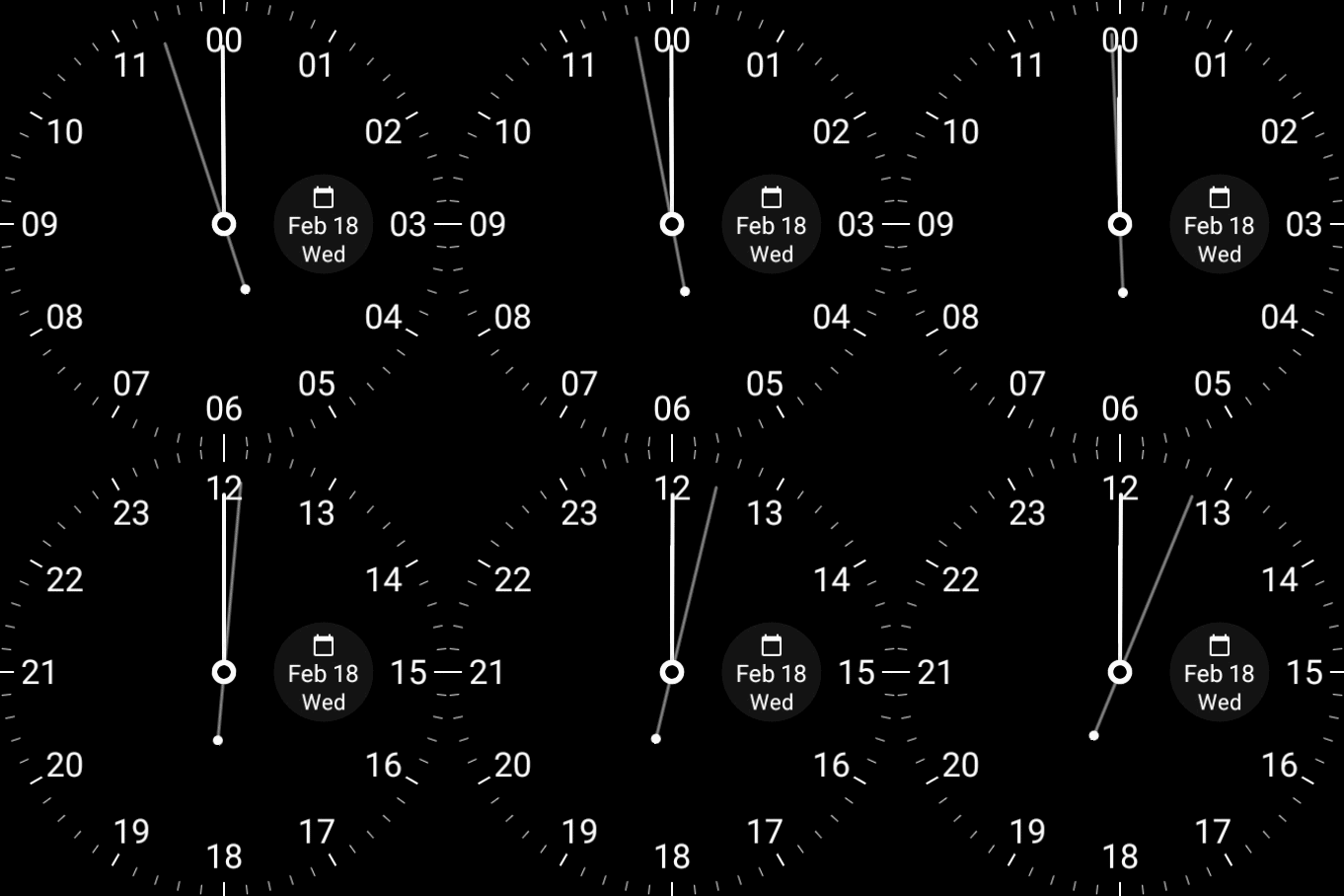
Smart 24 Hour Watch Face
Traditional 24-hour watch faces either force you to track two separate dials or cram all 24 numbers onto a single crowded dial, making it frustratingly difficult to read the time at a glance.
Era Watch Faces
Our watch face uses smart dial shift technology to dynamically change hour markings based on the time of day (00–11 during AM and 12–23 for PM hours).
Frequently Asked Questions
Deep-dive details regarding international compliance tracking standards and string conversions.
Why does the 24-hour clock use 00:00 instead of 24:00?
Both representations are technically standardized under ISO 8601. However, 00:00 is globally preferred to represent the exact beginning of a new day. 24:00 is occasionally utilized specifically to indicate the absolute end of an active day's timeline (e.g., store hours open until 24:00).
Where does the terminology 'AM' and 'PM' actually originate from?
These are Latin astronomical markers based on the solar meridian line. 'AM' stands for 'Ante Meridiem' (meaning before the sun crosses the meridian line, or before noon). 'PM' stands for 'Post Meridiem' (after the sun crosses the meridian line, or after noon).
How does sorting 24-hour string values compare to 12-hour values?
A 24-hour format with leading zeroes (e.g., 09:30, 14:15) naturally sorts chronologically when evaluated as basic strings. 12-hour strings (e.g., 2:00 AM, 11:00 PM) sort alphabetically incorrectly, forcing parsers to reconstruct date objects or complex logical checks simply to order chronological events.
Explore Era Series
Discover unified time tracking utilities and beautifully engineered adaptive watch faces designed around a continuous 24-hour timeline.