Aviation Fundamentals
Flight Time vs Block Time
An architectural breakdown of operational time tracking. Learn how the industry separates commercial gate metrics from regulatory aerodynamic logs.
Quick Summary
The fundamental metrics used across commercial operations and civil aviation registries.
Block Time Focus
Gate-to-Gate
Flight Time Focus
Takeoff-to-Touchdown
Standard Format
Decimal Hours (Tenths)
Primary Data Layer
OOOI Metrics
Primary Metrics
A concise semantic breakdown targeting strict structural reporting definitions enforced by civil aviation authorities.
What is Block Time?
Block Time represents the complete period from the moment an aircraft first moves from its parking place (Off-Block) for the purpose of taking off, until it comes to rest at the designated parking position (On-Block). This is the definitive financial window utilized by commercial operators to calculate pilot flight duty compensation, block hour costs, and scheduling schedules.
What is Flight Time?
Flight Time (often noted as Airborne Time or Air Time) strictly accounts for the operational duration spent entirely in the air. The log initiates the exact fraction of a second the landing gear tires leave the runway ground environment (Wheels Up) and terminates the precise moment the wheels touch down upon landing at the destination (Wheels Down). This index dictates aircraft legal component maintenance cycles, airframe logbook currency, and individual pilot landing tracking requirements.
Contextual Note: These terms form the operational core of pilot logging. Understanding how individual airframe and duty timestamps isolate is essential before computing advanced regulatory flight limits.
The OOOI Tracking Grid
Airlines automate tracking using specific status milestones called OOOI data points (Out, Off, On, In). Let's review a practical routing example between New York (JFK) and Boston (BOS) to observe the logbook math.
Off-Block (Out)
10:00 AMThe aircraft releases brakes and moves under its own power or tow at New York (JFK). This initiates the commercial Block Time log used directly for crew scheduling and payroll.
Wheels Up (Off)
10:25 AMFlight Time StartsThe exact moment the tires lose contact with the runway. Regulatory agencies track this specific window for airframe structural hours and engine maintenance cycles.
Wheels Down (On)
11:45 AMFlight Time EndsThe aircraft touches down on the runway at Boston (BOS). Active aerodynamic flight tracking stops here and enters logbook records.
On-Block (In)
11:55 AMThe aircraft comes to a final stop and the parking brake is set at the arrival gate at Boston (BOS). Block Time calculation concludes.
Calculated Block Time
01:55
Total commercial billable hours
Calculated Flight Time
01:20 (1.3)
Airframe maintenance & currency log
Operational Variance
How non-standard events alter logbook data. A quick structural look at how ground holding patterns and diversions impact both core metrics.
Ground Tarmac Delays
Block Time increases • Flight Time unchangedIf an aircraft leaves the JFK gate but sits in a mechanical or weather taxi queue for 45 minutes before takeoff, the entire wait is logged as Block Time (crew payroll continues). Flight Time does not accumulate until the wheels physically leave the runway surface.
Airborne Holding Patterns
Block Time increases • Flight Time increasesTime spent circling due to air traffic control congestion or severe weather impacts both values identically. Because the aircraft is moving under its own power and remains airborne, both metrics climb at a exact 1:1 ratio.
Route Diversions
Block Time splits • Flight Time resets per legDiverting to an alternate field creates a distinct landing. Pilots must close out the initial logbook entry upon touching down at the alternate airport, and initiate a completely new log for the subsequent leg back to the primary destination.
Clean Computations in the Cockpit
Pilots shouldn't carry out manual multi-base minute math conversions on a clipboard between legs. Modern cockpit workflows rely on precise, fluid digital utility tools to maintain absolute structural tracking integrity.
Explore Our Aviation Apps
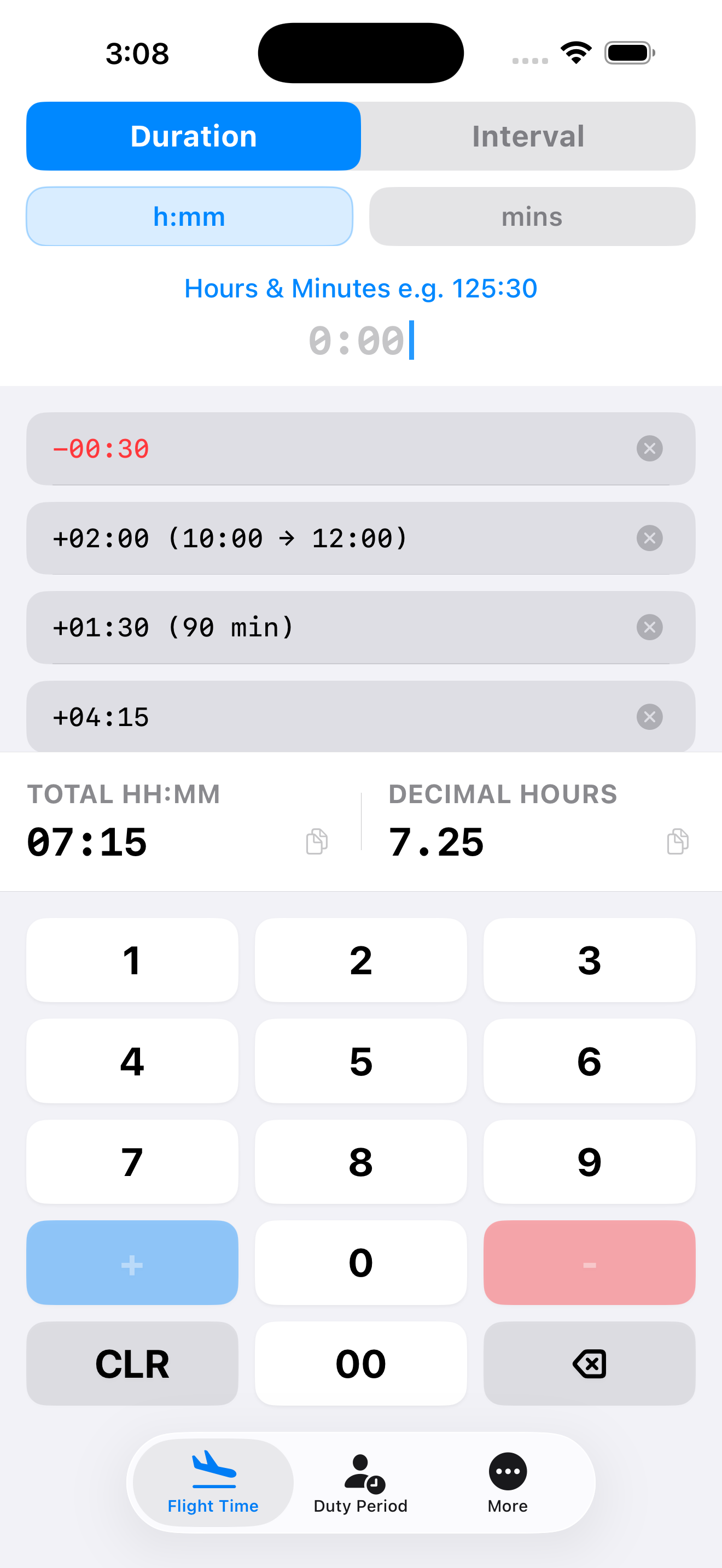
A lightweight, purpose-built app to computes flight time alongside customizable duty and FDP tracking.
Frequently Asked Questions
Deep-dive details regarding international compliance tracking standards and decimal parsing.
Why do pilots record logbook entries in decimal format instead of hours and minutes?
Aviation software and regulatory reporting engines require a base-10 decimal format to make cumulative rest and flight limit math straightforward. For example, a flight of 1 hour and 20 minutes is entered as 1.3 hours, eliminating multi-base calculations when adding hundreds of historical logs.
Can an aircraft accumulate Block Time without accumulating Flight Time?
Yes, and this happens frequently during ground delays. If an aircraft pushes back from the gate (Chocks Away) but spends 45 minutes in a de-icing or ground taxi queue before takeoff, that entire duration counts toward Block Time (crew payroll) but registers as zero Flight Time.
Which metric determines legal flight crew fatigue thresholds?
Both are utilized, but they feed into different structural limits. Flight Time Limitations (FTL) restrict pure airborne exposure to protect against operational fatigue, while Flight Duty Period (FDP) constraints monitor the broader window starting when a crew member checks in for work.
Explore Avion Utilities
Discover purpose-built aviation tools, calculators, and logs designed to streamline commercial flight logging and duty tracking.