Aviation Fundamentals
Flight Duty Period vs Duty Period
A critical deep dive into aviation regulatory constraints. Learn how reporting windows, block segments, and debrief buffers define your legal flight duty limits.
Quick Summary
The fundamental structural boundaries used across commercial operations to monitor crew fatigue and legal work shifts.
FDP Focus
Report-to-Final Gate
Duty Period Focus
Report-to-Debrief End
Segment Penalty
Max Cap Decreases
Primary Impact
Legal Fatigue Limits
Defining The Limits
Miscalculating the boundary line between FDP and Duty is one of the most common causes of regulatory rest violations.
What is Flight Duty Period (FDP)?
FDP represents the absolute continuous window that begins when a crew member reports for a duty period with the intent of conducting a flight, and terminates the instant the aircraft comes to a final rest (On-Block) at the gate following the last flight segment where the pilot operates as a crew member. FDP directly dictates your legal fatigue window.
What is Duty Period?
Duty Period accounts for the absolute entirety of a pilot's billable workday. It initializes at the exact same moment as FDP (Report Time), but extends all the way through the final post-flight operational duties, concluding at the end of a fixed Debrief Time buffer after the final engine shutdown.
Operational Rule: FDP limits aviation guidelines are fluid. Your maximum flight duty period changes drastically based on what time you sign in and how many landings you perform throughout the day.
Anatomy of a Duty Day
Let's isolate a multi-segment schedule step-by-step to track exactly where FDP cuts off while Duty Period keeps running.
Show Time / Sign-in
05:00 AMPilot signs in at the airport operations desk. The Duty Period and Flight Duty Period (FDP) both initiate simultaneously. This benchmark establishes the legal cap for the day based on planned segments.
Off-Block (Out) - Leg 1
06:00 AMThe aircraft pushes back for the first flight leg. Active flying operations commence.
On-Block (In) - Leg 3
01:30 PMThe aircraft parks at the final destination gate. Because no further flight segments are scheduled, the Flight Duty Period (FDP) instantly concludes here.
Debrief Window Concludes
02:00 PMThe contractual post-flight buffer (e.g., 30 minutes) terminates. The Duty Period officially closes.
Accumulated FDP
08:30
Evaluated against maximum legal limits
Logged Duty Period
09:00
Calculated via Report to Debrief markers
Multi-Leg Constraints
Under both FAA Part 121 duty limits and EASA FDP calculator matrix charts, the more flight legs you add, the more your maximum allowed day drops.
Early Morning Report Window (05:00 - 06:59)
Tightest FDP Caps of the daySigning in during early windows exposes the human body to higher circadian disruption. For a standard 1-2 leg operation, your FDP limit might start at 12 hours, but drops sharply down to 9 or 10 hours if additional multi-stop segments are added.
The Multi-Stop Landing Penalty
FDP drops by 30-45 minutes per segmentEvery additional landing increases operational fatigue. Regulatory frameworks shorten your maximum allowed duty hour window with each progressive intermediate stop to guarantee crew alertness through the final approach phase.
Avion Calc Configuration Solution
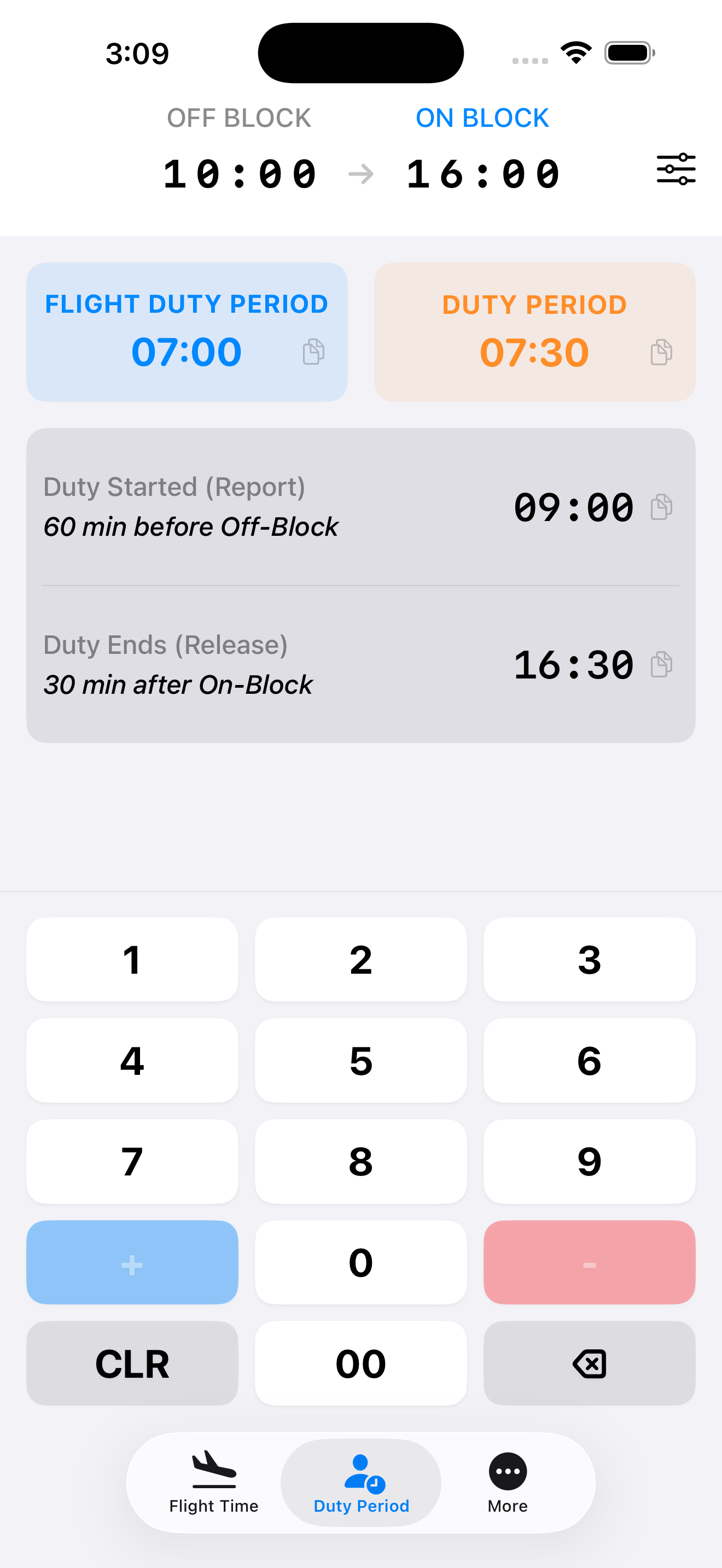
Eliminating manual lookup table dependencyInstead of tracking complex sliding compliance tables on paper, pilots can input their initial report time and toggle scheduled flight counts inside Avion Calc. The app processes the math instantly using custom buffers.
Automate Legal Duty Windows
Pilots shouldn't manually trace look-up matrices or calculate rolling duty caps between flight legs. Modern cockpit workflows rely on dynamic tools that track real-time duty parameters and guarantee absolute compliance framework integrity.
Explore Our Aviation Apps
A lightweight, purpose-built app that computes flight time alongside customizable duty and FDP tracking with custom report and debrief buffers.
Frequently Asked Questions
Explore common questions about flight duty periods (FDP), total duty time, reporting times, flight segments, and regulatory duty limitations.
When does a Flight Duty Period (FDP) start and end?
An FDP generally starts when a crew member is required to report for duty for an assignment involving a flight or series of flights. Its end is defined by the applicable regulatory framework. For example, under EASA rules, an FDP ends when the aircraft finally comes to rest and the engines are shut down at the end of the last sector on which the crew member operates. Under FAA Part 117, it ends when the aircraft is parked after the last flight and there is no intention for further aircraft movement by that crew member. Always refer to the rules applicable to your operation.
How does the number of flight segments affect maximum FDP limits?
The number of flight segments can reduce the maximum permitted FDP under applicable flight and duty time rules. For example, EASA and FAA Part 117 use tables that take factors such as reporting time and the number of flight segments into account when determining permitted limits. The reduction is not a universal fixed amount per additional segment; the applicable regulatory table and operating conditions determine the limit.
Does post-flight debrief count toward the Flight Duty Period?
It depends on the applicable regulatory framework and the nature and timing of the debrief. Under EASA definitions, the FDP ends when the aircraft comes to rest and the engines are shut down after the final operating sector. Post-flight duties performed afterward, including applicable debriefing, remain part of the broader duty period. Duties performed before or between operating sectors can form part of the FDP. Other regulatory frameworks may define the periods differently.
Can a pilot exceed the maximum Flight Duty Period limit during a flight?
Some regulatory frameworks provide limited provisions for extending an FDP in unforeseen circumstances, subject to specific conditions and procedures. These provisions are not a general allowance to exceed planned limits. For example, EASA has commander’s discretion provisions, while FAA Part 117 has its own extension requirements. The applicable rules, reporting procedures, and operator policies must be followed.
The information provided is for general reference only. Flight and duty time requirements vary by aviation authority, aircraft operation, and operator procedures. Always consult the applicable regulations and your operator's approved manuals.
Explore Avion Utilities
Discover purpose-built aviation tools, calculators, and logs designed to streamline commercial flight logging and duty tracking.